Return
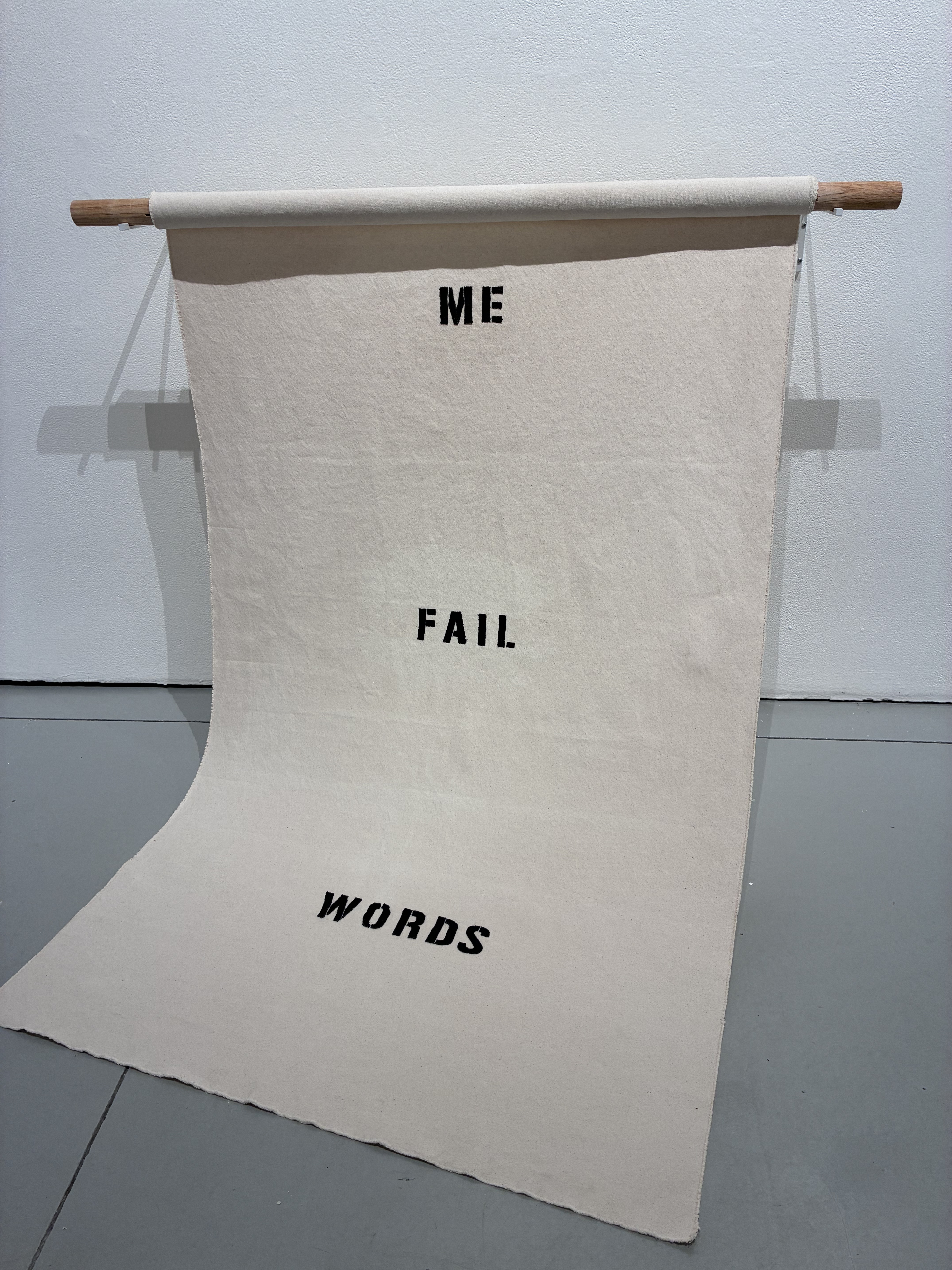
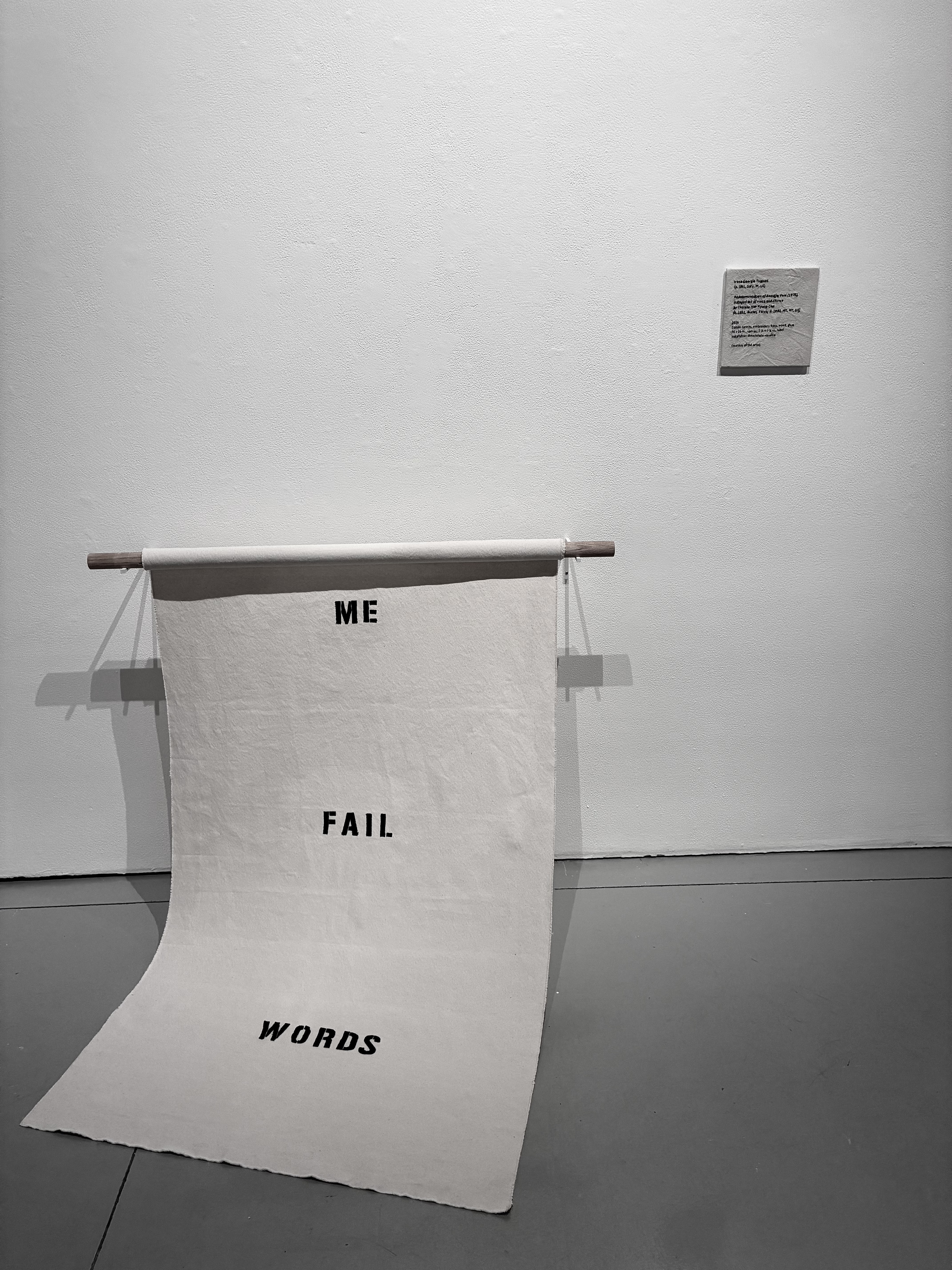
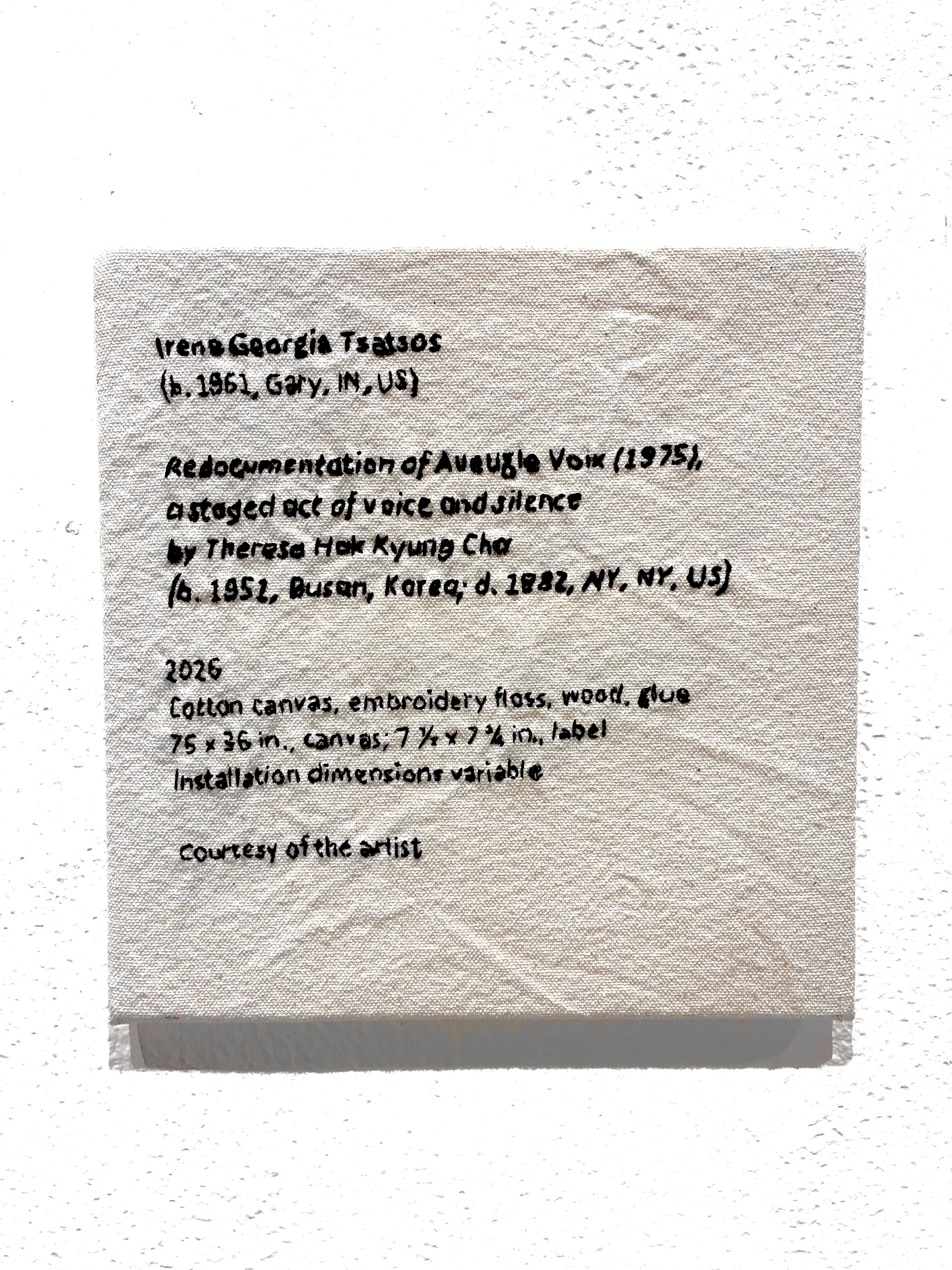
Echo/Ηχώ main image Echo/Ηχώ installation Echo/Ηχώ label detail
Images — top: installation; bottom: label detail

Echo/Ηχώ

2026
Cotton canvas, embroidery floss, wood, glue
76 x 36 in., canvas; 7 ½ x 7 ¾ in., label
Installation dimensions variable

This piece redocuments a photograph of an artwork, a performance/speech act entitled Aveugle Voix (1975) by Theresa Hak Kyung Cha. In other words, it documents documentation – an echo of an echo (or of Echo). I first learned of Cha’s work when writing about Antigone for my master’s thesis, which cites Cha’s novel/memoir Dictee, which among other things cites Greek mythology. I was then, and remain today, drawn to expressions of women/femme agency despite efforts to silence them/us, speech that persists despite law, custom, violence, or norms that insist it should not. That tension is central to Antigone’s experiences and to Cha’s practice, which I honor in Echo/Ηχώ, along with Cha’s references to Greek mythology and the evergreen question it poses: who is permitted to speak, and at what cost?1

The phrase “me fail words” sits at the center of this redocumentation as both injury and origin, cause and consequence. Its “incorrect” syntax registers as a fracture, a refusal. In Cha’s work, failure reflects historically and structurally enforced limits placed on what can be said, in what language, by whom, and with what legitimacy. “Me fail words” names the moment when language struggles under the weight of what it carries—displacement, grief, state violence, erasure—as well as also the moment when that struggle becomes visible as evidence. The failure is both record and assertion.

Today we live within competing regimes of truth: a constant stream of testimony and counter-testimony, footage and denial, and narratives shaped by algorithms, “moderation policies” and censorship, legal threats, and rhetorical policing. “Me fail words” resonates here as the sound of public speech under surveillance. It is also

1 I wrote this eight days following the murder of Renee Nicole Macklin Good on January 7, 2026, by ICE agent Jonathan Ross in Minneapolis, MN. On January 10, 2026, US administration officials, including the vice-president and a DHS spokesperson, legitimated the murder, citing self-defense despite video, extensively analyzed, indicating otherwise. Asked whether deadly force was necessary, the president answered by calling the women “highly disrespectful of law enforcement,” repeatedly referring to Good’s wife as her “friend” (The New York Times, January 12, 2026). The video – released by DHS – does not exonerate the ICE agent, or show that he was assaulted, as claimed. Instead, it shows a verbal confrontation as Good attempts to drive away, followed by Ross firing into the vehicle.

Yet – “One of the key underpinnings of the Christian fascist movement is that women know their place, respect their husbands, don’t talk back and don’t meddle in the affairs of men. That is the message DHS sent by releasing the video, and it’s why they have doubled down, repeatedly, on the ‘he was threatened’ narrative: because to them, he WAS threatened, because there was a woman in front of him who didn’t need a man, didn’t want a man, didn’t respect him as a man, and mocked his authority as a man. … They released the video to tell all American women that this is what you get for disrespecting the natural order of the universe” (Todd Alcott, filmmaker, in a social media post). The authority of the ICE agent was challenged by the words of Good and her wife. They mocked him. The ICE agent was threatened by their voices, so he shot and killed Good.

The exhaustion of language in the face of repeated catastrophe, when speech becomes sheer persistence.

As an artist with a 30-year parallel track of work as a curator, I am also troubling the conventions, authority, and hierarchies of museum display and academic citation. Redocumenting is a way to reveal mediation rather than hide it—to show how institutions wash uncertainty into certainty, how labels stabilize what is contested, how citation can function as a gatekeeping apparatus that decides what counts as knowledge. Echo/Ηχώ, in this context, becomes a refusal of institutional fluency as the only legitimate mode of address. It insists that broken language, partial language, translated language, and silenced language are not marginal to life—they are often where it is most truthful.